
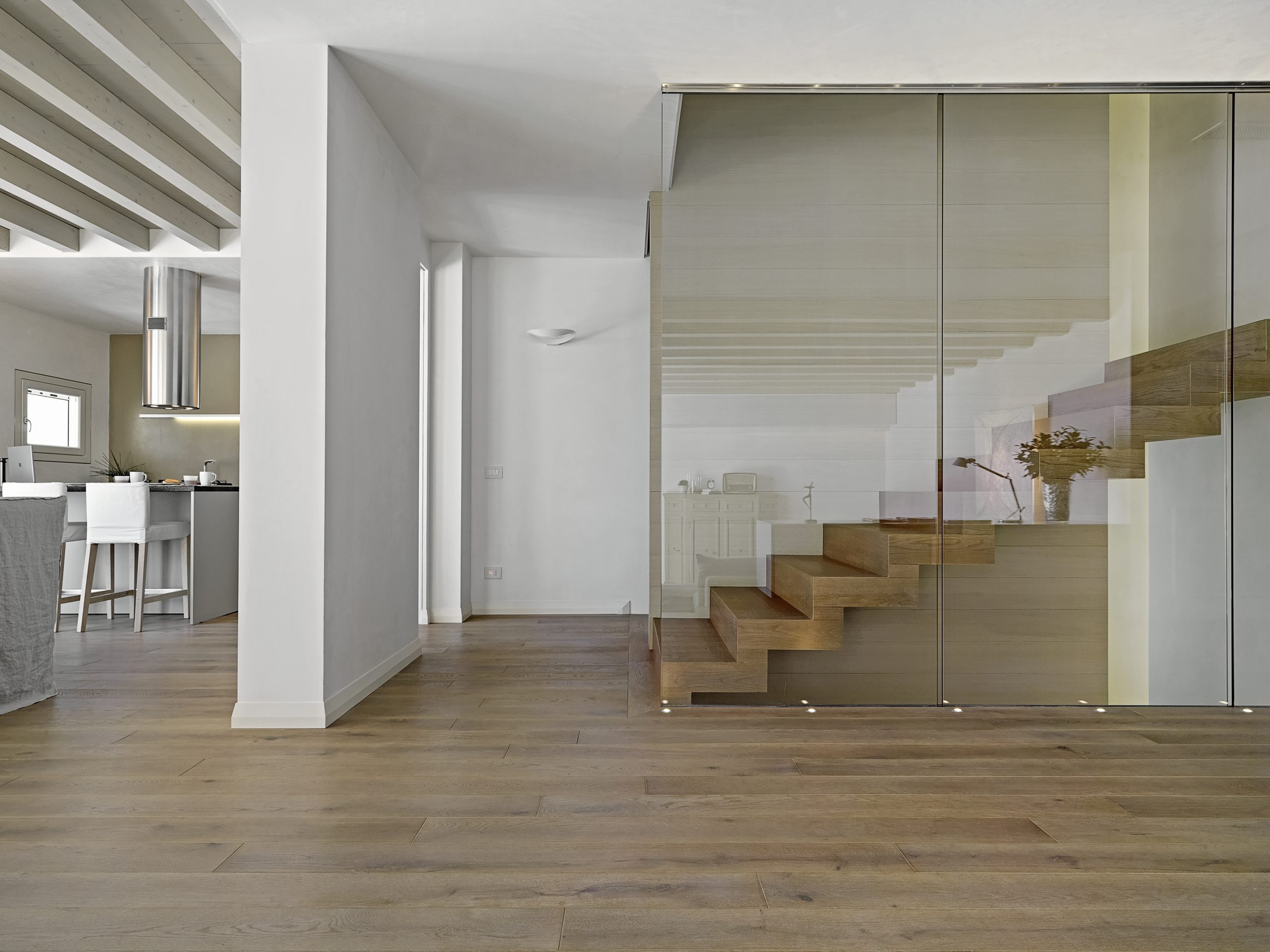
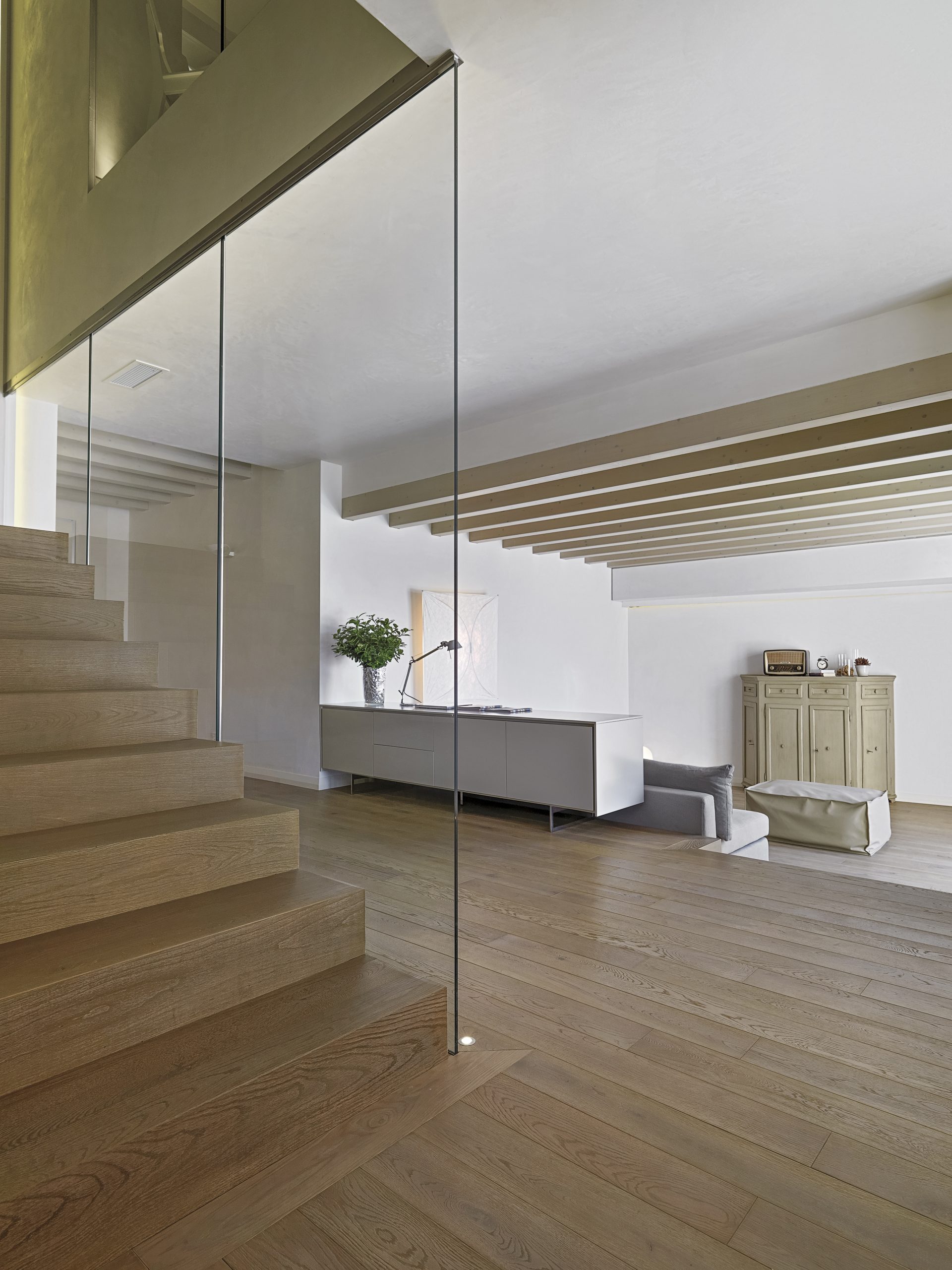
In Rotterdam, we installed a block staircase with glass panels extending to the ceiling. This creates the illusion that the staircase occupies a separate space, while still remaining visible from the living room and kitchen.
Design
The staircase is made of oak and treated with a clear oil matching the color of the oak floor. Since the floor is treated with the same oil (real oak flooring), it is easier to create a seamless transition. With PVC or laminate floors, achieving this match is often more challenging.
What makes a block staircase so special?
What makes a block staircase unique is that its construction is invisible. The stringer consists of steel pins anchored into the wall, over which the steps are slid and secured. You can imagine that this cannot be mounted in a simple drywall. Block staircases require a load-bearing wall. Because the steps are slid over pins, they are made extra thick. Normally, we use 4.1 cm for standard staircases, but for block staircases, the average thickness ranges from 6.0 to 8.0 cm.
Another key feature of a block staircase is the connection between the steps and risers. These are glued together at a 90-degree miter, meaning the staircase does not have the so-called nosing (the overhang of the step). Additionally, as you can see in the photo, the steps and risers have the same thickness, whereas risers are normally much thinner.
Would you like to learn more about the possibilities of a block staircase, or perhaps a similar type with glass panels? You can always reach us by phone or email—our team is happy to assist you.
Schedule an appointment or request a quote
At MH-stairs, we strive for personal contact with our clients. We are happy to guide and advise you in selecting the right staircase(s) for your project. Request a free quote or schedule an appointment at our studio. For every project, we create a custom design.