
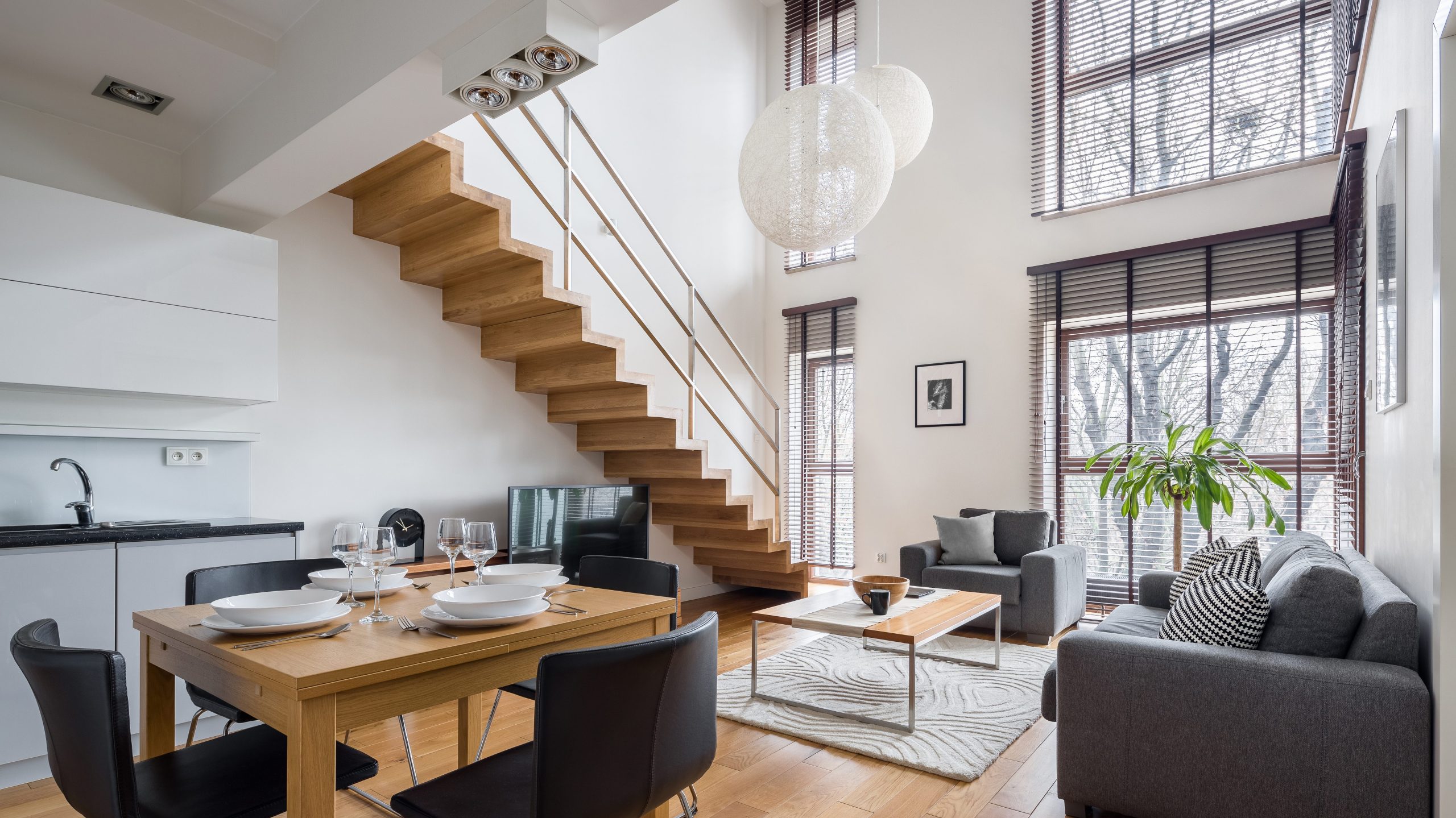

Purchasing a staircase involves many considerations. Not only is the design important, but the technical aspects should not be overlooked. After all, a staircase is a structural element in your home. The design aspect is an added bonus, but certainly not unimportant.
This article is intended for informational purposes and serves as a guide to help you select your ideal staircase.
We have compiled a list of key terms featuring the most common words. Some of these terms are also shown in the image on the left..
Key Terms
- Treads: The surfaces you step on when using the staircase. When walking up or down, your feet rest on the “treads” of the staircase.
- Stringer: The structural element of the staircase on which the treads rest. There are different types of stringers. The most traditional stringers consist of two side elements, with the treads mounted between or on top of them. Another type is the central stringer, which is a single element placed in the middle of the staircase (under the treads). Floating staircases are another type, where the stringer is usually hidden in the wall. Pins protrude from the wall, over which the treads are then slid.
- Headroom: The clearance height of the staircase, or the distance from the treads to the ceiling. There must be enough space here to ensure you can move comfortably without hitting your head.
- Risers: The vertical elements placed between the treads. Risers are used to create a “closed staircase.” Stairs without risers are called “open staircases.” Risers are typically set slightly inward so that the tread overhangs slightly. In a box staircase, the risers and treads are glued at a 90-degree angle, creating a modern design.
- Nosing: In our company, also referred to as the “nose of the tread.” As described above, risers are typically set slightly inward, causing the tread to overhang slightly. This overhanging part is called the nosing.
- Balustrade: The railing along the staircase and mezzanine. The balustrade ensures safe movement along the staircase, preventing falls from the sides. It consists of spindles and/or glass panels and handrails.
- Handrail: The element you can hold onto while using the staircase. The handrail can be mounted on the wall, supported by spindles, or sometimes by glass panels in the railing.
- Newel Post: The starting post at the beginning and end of the staircase. The balustrade (with handrail) is attached to the newel post and stringer, providing structural support and connecting to the mezzanine.
- Mezzanine: The open space that forms between multiple floors. A balustrade is installed here to prevent falls.
- Riser Height (Rise): The vertical distance between two treads is called the rise of the staircase.
- Tread Depth (Run): The depth of the tread is referred to as the run of the staircase.
In the Netherlands, the Building Decree (Bouwbesluit) sets the minimum requirements for a safe staircase. These requirements differ for new construction and existing buildings. For example, the Building Decree specifies the minimum rise and run for staircases. You can find all the requirements included in the Building Decree on the Dutch government’s website..
Schedule an appointment or request a quote
At MH-Trappen, we prioritize personal contact with our clients. We are happy to guide and advise you in selecting the right staircase(s) for your project. Request a quote without obligation or schedule an appointment at our studio. For every project, we create a custom-designed staircase.